If you've spent any time on Warhammer Community, Goonhammer or the wargaming subreddits lately, you'll have seen the same thing on repeat: 11th Edition 40K is rewriting how terrain works on the tabletop. Cover is different. Line of sight is different. Objectives now live inside the terrain instead of next to it. And Games Workshop is officially pushing standardised terrain footprints into matched play.
For anyone hauling boxes of ruins to club night, this is a big deal. Most of what you already own probably still works, but the kinds of pieces that matter most have shifted.
Here's a plain-English breakdown of what's changed, and what that means for the terrain you actually want on your table.
The four rule shifts worth knowing
Most of the 11e terrain conversation comes down to four ideas. None of them are exotic on their own, but together they change how you build a board.
1. Cover now hurts the shooter, not the saver.
Instead of cover giving your unit +1 to its save, the attacker takes −1 to their Ballistic Skill. That's a meaningful nerf to high-volume shooting, and it means parking infantry inside a piece of terrain is genuinely valuable again.
2. Hidden is a real keyword.
Infantry, Beast and Swarm models inside a terrain area can stay Hidden as long as their unit hasn't shot in the current or previous player turn. While hidden, enemy units can only spot them within roughly 15". In practice, your gunline isn't sniping a backfield squad turn one unless it gets close.
3. Obscuring is back, properly.
Many terrain areas are Obscuring, which means a line of sight cannot pass through them. Not just blocked at one point: the whole footprint is opaque. Pieces that fully break LOS are now far more valuable than pretty silhouettes you can shoot through.
4. Terrain is the objective.
Most objectives no longer live as a token in the middle of the table. You score by touching the edge of the terrain footprint, so the terrain piece itself is the objective.
If you want the rule-text version, Warhammer Community's terrain rules article and Goonhammer's hot take are the two reads worth your time.
The new footprint sizes
Alongside the rules, GW is selling official footprint templates, and the community has already published free 3D-printable versions on MakerWorld. The standardised sizes you'll see in matched-play scenarios are:
- 4 × Large Rectangles: 7" × 11.5"
- 2 × Large Right-Angle Triangles: 8" × 11.5"
- 4 × Medium Rectangles: 6" × 4"
- 2 × Long Lines: 10" × 2.5"
- 4 × Short Lines: 6" × 2"
Three Large Rectangles plus a triangle is enough to break sightlines across a 60" deployment edge. The Medium Rectangles are where most of your "ruin cluster" terrain lands. The Lines are scatter and rubble: low pieces that break charges and chip cover on the approach.
What this means for the terrain on your table
The honest answer: a lot of older terrain still works, but the priority of what to add next has changed.
Big Obscuring pieces matter more than ever
If a piece doesn't fully block LOS, it's now competing for table space with pieces that do. Tall, dense ruins, the kind you can hide a unit behind without an opponent claiming "I can see one antenna", are the new MVPs. A pair of Obscuring footprints in the middle of the board defines the whole game.
For sci-fi tables, modular ruins with solid walls do the heavy lifting here. Our Medium Infected Ruins sci-fi terrain sits in this lane: sci-fi ruin pieces with full-height walls, rather than the kind of skeletal frames you can shoot straight through.
Area terrain becomes a hiding place
Hidden makes the interior of a ruin valuable, not just the edges. Pieces with proper internal space, somewhere a Tactical squad can sit and not be seen until something gets close, are now scoring real points just by existing.
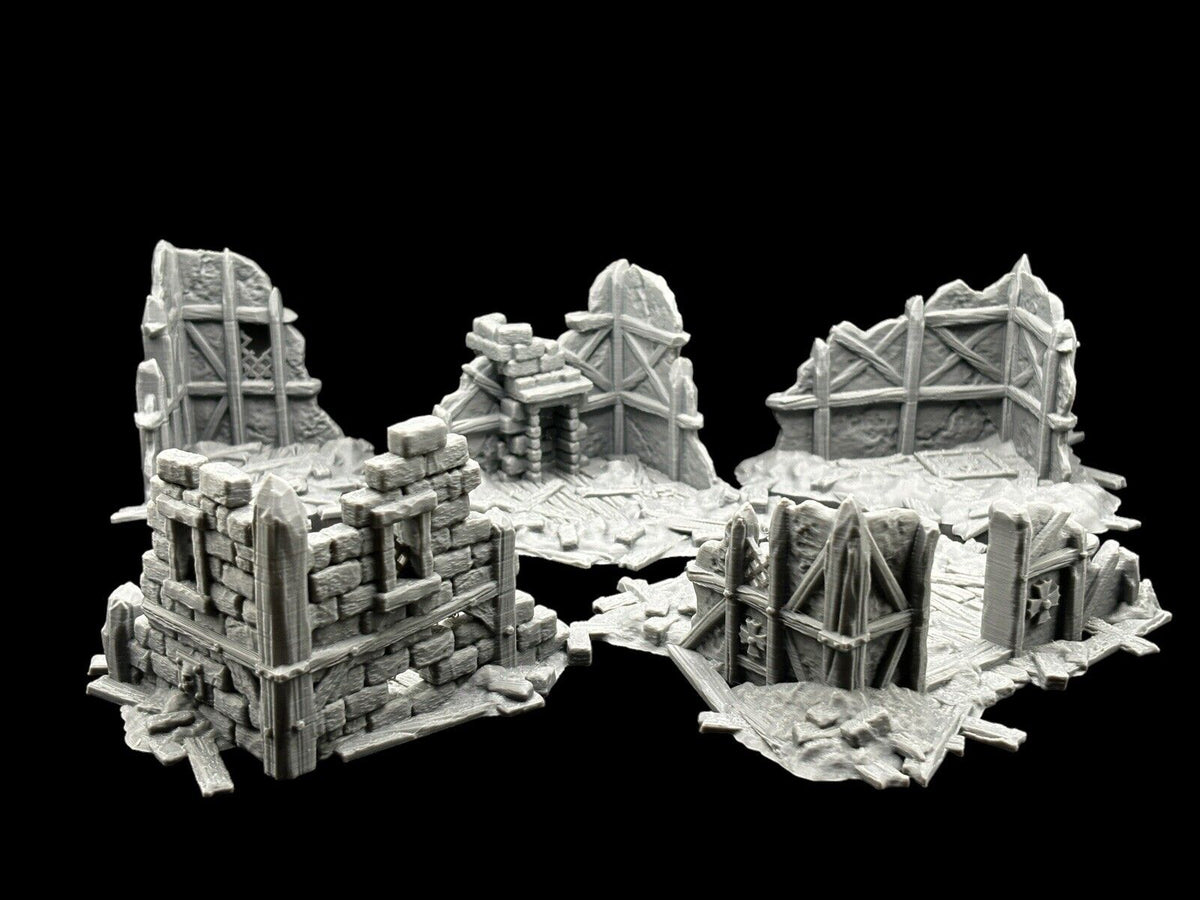
The 28mm Building Ruins and Ruined Tower House work well as crossover pieces if your group plays both 40K and fantasy. They're ruined buildings that occupy real table space rather than just decorating it.
Scatter fills the small footprints
The Short Line and Long Line footprints want low scatter: rubble, barricades, crates, craters. It isn't flashy, but it's where charges get re-routed and where infantry pick up cover on the approach.
A handful of 28mm staples covers the Lines neatly. Craters, scatter terrain and stacks of firewood or crates all work as universal Short-Line dressing.
Smaller boards, denser terrain
GW is leaning into more compact official matched-play setups, which means more terrain pieces in a smaller area. That favours modular ruin systems: pieces you can rearrange to fit a layout rather than monolithic builds that only sit one way.
Building an 11e-ready board on a budget
Here's the pragmatic part. A full official terrain set from GW adds up fast, and 3D-printed alternatives are where most clubs and home gamers are landing. A handful of well-chosen STLs or printed pieces covers every footprint size with change to spare, especially if you mix and match between sci-fi ruins (for Obscuring), area terrain (for Hidden) and scatter (for the Lines).
If you're starting from zero, the sequence we'd suggest is:
- Two big Obscuring pieces first. Without LOS breakers, the table plays like an open field and 11e shooting is brutal.
- One or two ruin clusters. These fill your Medium Rectangles and give Hidden somewhere to live.
- A pile of scatter. Barrels, crates and craters: cheap, fast to add, and the difference between "table" and "battlefield".
Pre-painted terrain is having a moment in the news too. GW recently announced its own pre-painted line. For most hobbyists, though, unpainted 3D-printed terrain is still the unbeatable cost-per-footprint option, especially when you'd want to paint it to match your own scheme anyway.
The takeaway
11th Edition didn't break anyone's terrain collection, but it did change what's worth adding next. Big Obscuring blocks, area ruins with real interior space, and a healthy pile of scatter for the Lines: that's the recipe.
If you're stocking up, browse the Molten Prints terrain range for 3D-printed sci-fi ruins, medieval crossovers and scatter to fill out every footprint on the new 11e board. Everything is supplied unpainted and ready to prime, so it slots straight into whatever scheme you're already running.